I'm tracking 88,000+ Amazon products and 28 million price points. In backtests, my Strong Buy signal was right 73.6% of the time and my Strong Wait signal 84.4%.
⌕
How it works
01
Search any product
Search by name or paste any Amazon link. I pull fresh price data so you always see what the product is selling for right now.
02
See the full price history
View years of pricing data in one chart. See where the current price sits relative to its historical range and average.
03
Act on the signal
I score the price 0–100 based on historical percentile, recent trend, and seasonality. Signals range from Strong Buy to Strong Wait — most products land between the extremes — so you know exactly where you stand.
Highlighted Deals
Get notified when major sales hit
Prime Day, Black Friday, and surprise deals — straight to your inbox.
Can't find what you're looking for? Browse Amazon directly.
About TimeYourBuy
Hi — I built TimeYourBuy on nights and weekends because I got sick of Amazon labeling something a "deal" when it was actually the highest price it had been all year.
The site tracks 88,000+ Amazon products and 28 million price points across years of price history. When you look up a product, you see the full chart, where today's price sits in that range, and a plain-English signal: Strong Buy, Buy, Fair, Wait, or Strong Wait. I backtested the scoring on historical data — the Strong Buy signal was right 73.6% of the time.
I don't sell products. I don't push you to buy. I just show the data. If Amazon's price today is a rip-off vs. its own history, I want you to know before you check out.
Price History
Up to 3 years of historical pricing data for every product
My scoring engine compares the current price against a rolling 12-month price history. The score (0–100) reflects how far today's price sits below its historical average, adjusted for category, volatility, and — for commodity categories like Memory and Storage — live market conditions. I validated the signals on a survivorship-corrected backtest: Strong Buy calls were correct 73.6% of the time.
Who's behind this
Just me — one person. If you spot a wrong signal, a stale price, or a broken guide, email me at timeyourbuy@gmail.com. Real inbox, real reply.
Affiliate disclosure
TimeYourBuy is an Amazon Associate. I earn a small commission when you buy through my links — at no extra cost to you. It's how the site stays free and how I pay for the data feed.
TimeYourBuy doesn't sell your data, doesn't track you across the web, and doesn't set tracking cookies. We store your email only if you ask us to send you a price alert — and we delete it the moment you unsubscribe.
Here's exactly what that means.
What we collect
Email address — only if you sign up for a price alert. We use it once: to send the alert you asked for. We never sell it, share it, or send you anything else.
Anonymous usage analytics — we use Umami, a privacy-respecting analytics tool hosted on Umami Cloud. It records page views, referrer, browser type, and operating system in aggregate. No cookies. No fingerprinting. No cross-site tracking. No personal identifiers. Data is kept for 12 months, then deleted.
Search queries — the searches you run on the site are logged so we can improve product matching. They are not linked to your email or any personal identity.
What we don't collect
Payment information — we don't process payments
Advertising or tracking cookies of any kind
A behavioral profile of you
Anything we'd need in order to sell your data, even if we wanted to
Price alerts
When you register an alert, we store two things: your email and your target price. When the price hits your target, we send one email. That's it.
Every alert email includes an unsubscribe link that immediately deactivates your alert. We also send a List-Unsubscribe header so Gmail and other email clients can offer a one-click unsubscribe button. If you don't unsubscribe and your alert sits unused for 12 months, we delete it.
Amazon affiliate links
TimeYourBuy participates in the Amazon Associates Program. When you click through to a product, Amazon may set its own cookies under their privacy policy — we have no control over that. We earn a small commission on qualifying purchases at no extra cost to you. This is what keeps the site free.
Cookies
We don't set any first-party tracking cookies. Umami, our analytics tool, is cookie-free by design.
Data retention
Alert data: deleted when you unsubscribe or remove the alert, or after 12 months of inactivity — whichever comes first. Alerts stay active until you remove them (at most one email every 3 days per product).
Analytics data: kept in anonymous, aggregate form for 12 months, then deleted.
Your rights (GDPR / CCPA)
Depending on where you live, you may have the right to:
See the data we hold tied to your email
Delete all of it
Opt out of any future emails (the unsubscribe link in any alert does this immediately)
Email timeyourbuy@gmail.com to exercise any of these rights. We respond within 30 days.
Contact
Questions, concerns, or you spotted something we should fix? Email timeyourbuy@gmail.com.
Terms of Service
Last updated: April 8, 2026
By using TimeYourBuy, you agree to these terms. If you don't agree, please stop using the site.
What TimeYourBuy is
TimeYourBuy is a price intelligence tool. We track publicly-available Amazon pricing data and provide buy/wait signals based on historical price analysis. We are not a retailer, marketplace, or financial advisor.
No purchase guarantees
Prices and availability change constantly. Our signals represent our best analysis of historical data — they are not guarantees of future pricing. Always verify the current price on Amazon before purchasing.
Accuracy of information
We do our best to keep price data accurate and up to date. However, prices are sourced from third-party data providers and may not reflect real-time availability or seller-specific pricing.
Affiliate relationships
TimeYourBuy participates in the Amazon Associates Program. We earn a commission on qualifying purchases made through our links. This does not affect the integrity of our buy signals — we score products objectively based on price history.
Acceptable use
You may use TimeYourBuy for personal, non-commercial use. You may not scrape, copy, or redistribute our price data or signals in bulk without written permission.
Limitation of liability
TimeYourBuy is provided "as is". We are not liable for any purchasing decisions made based on our signals. Always do your own research before making a purchase.
Changes
We may update these terms from time to time. Continued use of the site constitutes acceptance of any changes.
In short: When I tested my signals on price data I'd never used before, STRONG BUY was right 73.6% of the time and STRONG WAIT was right 84.4% of the time. The numbers barely change even when I include products that got discontinued. Full details below.
Here's exactly how I calculate buy and wait signals, and how well they actually performed when I tested them.
549,927price checks analyzed
~10,000products in the backtest
4 years2022–2025
20%saved for testing
How I calculate the score
Every product gets a score from 0 to 100. The score combines four things:
What I look at
Weight
What it tells you
Price vs. its 12-month range
35%
Is today's price near the low or near the high? Lower = better deal
Time of year
25%
Does this category usually drop in price this month?
Recent direction
20%
Has the price been moving up or down over the last 30 days?
How fresh the deal is
20%
Did the price just drop, or has it been at this level for a while?
The score becomes a signal: STRONG BUY (79–100) · BUY (55–78) · FAIR (41–54) · WAIT (23–40) · STRONG WAIT (0–22). When I have less price history for a product, I show a lower confidence number so you know the signal is less certain.
How well do the signals actually work?
To check my signals, I set aside 20% of my data and ran the algorithm on it as if I were seeing it for the first time. A buy signal is "right" when the price doesn't drop sharply afterwards — meaning you didn't miss a better deal. A wait signal is "right" when the price does drop — meaning waiting saved you money. I measure each two ways: looking at the price exactly 30 days later, and looking at the lowest price seen during those 30 days.
Buy signals
A buy signal is "right" if you didn't miss a better deal — i.e., the price didn't drop more than 5%.
Signal
Price didn't drop by day 30
Price never dropped in 30 days
Avg price change
How many cases
STRONG BUY
88.4%
73.6%
+18.7%
12,477
BUY
80.9%
58.5%
+6.4%
29,629
"Held throughout" is the stricter test — it catches cases where a cheaper price appeared briefly even if the price recovered by day 30. For comparison: always buying immediately would pass the strict test 50% of the time.
Wait signals
A wait signal is "right" if a cheaper deal appeared — i.e., the price dropped at least 5% (it doesn't measure whether prices rose).
Signal
Price dropped by day 30
Price dropped at some point in 30 days
Avg price change
How many cases
WAIT
35.7%
64.2%
−4.7%
39,935
STRONG WAIT
57.9%
84.4%
−14.5%
896
"Dropped at some point" is more lenient because a price can briefly dip and then recover. For comparison: always waiting would catch a drop at some point 50% of the time, and random guessing ≈ 40%. FAIR signals (29,026 cases) had an average price change of +0.9% — neither a clear buy nor a clear wait.
Does my confidence number actually mean anything?
When I say a signal is "75% confident," is it actually right 75% of the time? Below, I plotted what I predicted against what actually happened. Dots close to the dashed line mean my predictions matched reality. Dots far from the line mean I was over- or under-confident.
On average, my STRONG BUY confidence was off by 2.6 percentage points across 12,477 cases. BUY was off by 1.2 across 29,629 cases. Both are well within the range I'd consider reliable (under 5 points). Based on my test set, looking 30 days ahead.
What about products that got discontinued?
My catalog is products that are still on Amazon today. Products that disappeared — often after a fire-sale discount — aren't in my data, which could make my results look better than they really are. To check, I compared two groups in my test set: products that are still being sold, and products that got pulled off Amazon afterwards.
Signal
Still selling
Later removed
Difference
STRONG BUY
73.7%
72.5%
−0.1 pts
BUY
58.6%
57.1%
−0.1 pts
WAIT
64.4%
62.5%
−0.1 pts
The gap is tiny — under 0.2 percentage points for every signal. STRONG WAIT showed a slightly bigger gap (+0.3 points), but only 18 discontinued products fell into that bucket, so the difference isn't meaningful.
Where my signals fall short
Discontinued products — my data is mostly products still on Amazon today. Products that got removed are underrepresented, so my success rates may be slightly higher than reality.
Pricing assumptions — my test assumes prices tend to bounce around an average. For memory and storage products, prices follow industry-wide trends, which the test doesn't fully capture (the live system handles this separately).
What I tested — the backtest covered ~10,000 products, mostly consumer electronics — a subset of the 88,000+ the site tracks today. Results apply to that cohort, not all of Amazon.
Stable-price products — my results focus on products whose prices change at least a few times a month. Products with rarely-changing prices weren't included in this test.
STRONG WAIT is rare in practice — real products seldom stack every bearish factor at once, so on any given day only a handful of live products carry a STRONG WAIT. The 84.4% figure is backtest-validated, not a live-catalog guarantee.
Data source — all my price history comes from Keepa, which records prices only when they change. For products with stable prices, I have fewer data points to work with — I account for this by lowering the confidence shown to you.
Questions or feedback?
Email timeyourbuy@gmail.com. If something here is unclear or you spot a problem, please let me know.
Loading product…
BLACK+DECKER
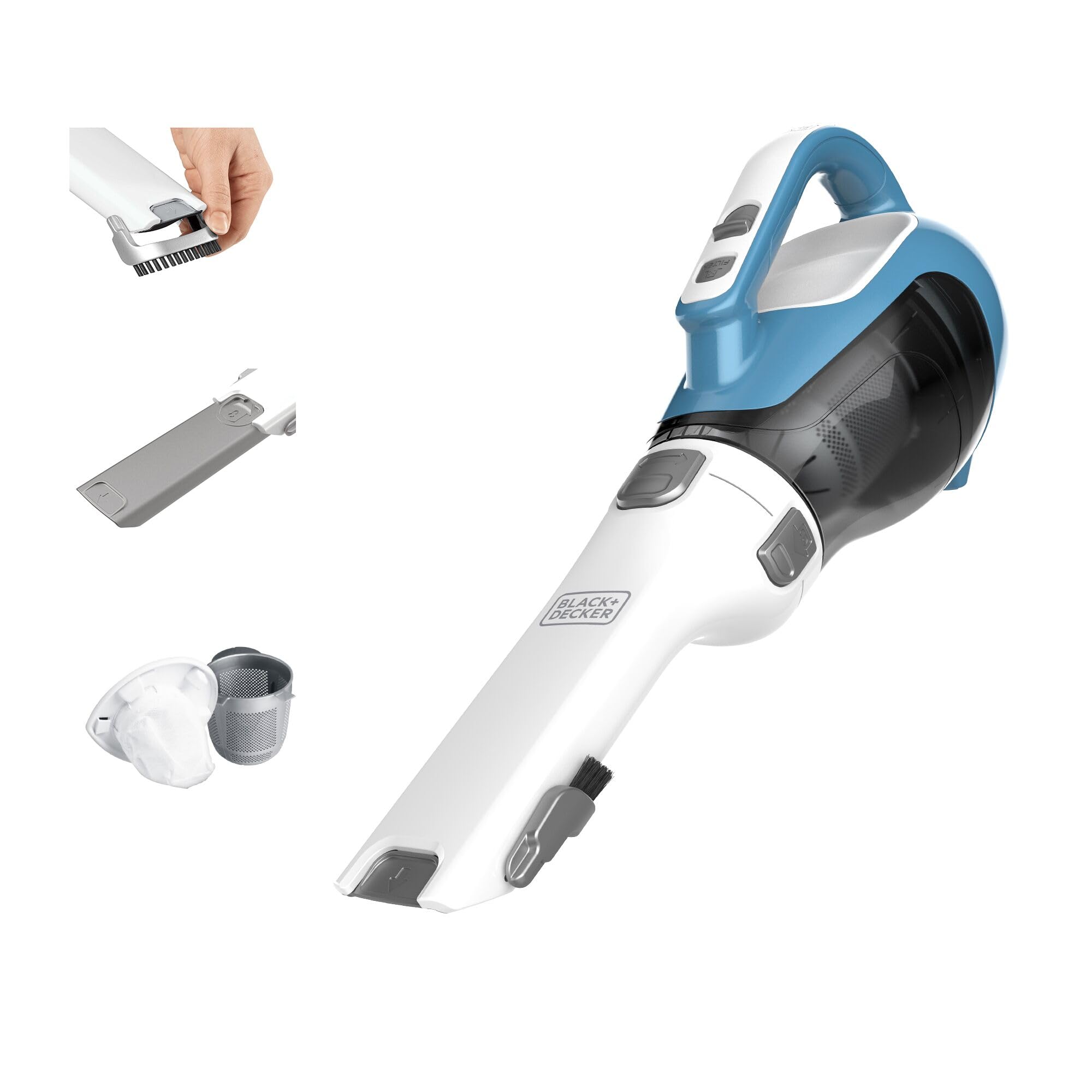
Black+Decker, Dustbuster AdvancedClean Handheld Vacuum Cordless, Compact Home and Car Vacuum with Crevice Tool, Rotating Nozzle and Charging Station
$44.93
Signal: STRONG BUY
The Black+Decker, Dustbuster AdvancedClean Handheld Vacuum Cordless, Compact Home and Car Vacuum with Crevice Tool, Rotating Nozzle and Charging Station is currently $44.93. Over the last 12 months it has typically held between $42.99 and $59.99 (prices that lasted at least a day), with a typical price of $52.79. Today's price is cheaper than 99% of the past year's prices, which TimeYourBuy classifies as a STRONG BUY signal. The price has changed 79 times in the last year, with the lowest prices typically appearing in September, November, and December.
Common questions
When is the cheapest time to buy Black+Decker, Dustbuster AdvancedClean Handheld Vacuum Cordless, Compact Home and Car Vacuum with Crevice Tool, Rotating Nozzle and Charging Station?
The best sustained price for Black+Decker, Dustbuster AdvancedClean Handheld Vacuum Cordless, Compact Home and Car Vacuum with Crevice Tool, Rotating Nozzle and Charging Station was $42.99 — the lowest it has held for at least 24 hours. Historically, prices drop most often in September, November, and December.
Is now a good time to buy Black+Decker, Dustbuster AdvancedClean Handheld Vacuum Cordless, Compact Home and Car Vacuum with Crevice Tool, Rotating Nozzle and Charging Station?
At $44.93, today's price for Black+Decker, Dustbuster AdvancedClean Handheld Vacuum Cordless, Compact Home and Car Vacuum with Crevice Tool, Rotating Nozzle and Charging Station is cheaper than 99% of the past year's prices. TimeYourBuy classifies this as a STRONG BUY signal.
What was the lowest price for Black+Decker, Dustbuster AdvancedClean Handheld Vacuum Cordless, Compact Home and Car Vacuum with Crevice Tool, Rotating Nozzle and Charging Station in the last year?
The 12-month best sustained price was $42.99, which is 4% below the current price of $44.93.
How often does Black+Decker, Dustbuster AdvancedClean Handheld Vacuum Cordless, Compact Home and Car Vacuum with Crevice Tool, Rotating Nozzle and Charging Station go on sale?
Over the last 12 months, the price changed 79 times. The 12-month sustained range is $42.99 – $59.99.
Track the price history and get buy/wait signals for Black+Decker, Dustbuster AdvancedClean Handheld Vacuum Cordless, Compact Home and Car Vacuum with Crevice Tool, Rotating Nozzle and Charging Station on TimeYourBuy.